The German stock exchange (Frankfurter Wertpapierbörse, FWB) is not just another capital market. It is the venue where the shares of Germany’s largest industrial groups change hands, and a reliable gauge of the health of the German economy. To understand its standing it helps to look at both its history and how it works today.
All trading is settled in euros and the overwhelming majority of volume runs through the electronic XETRA system. The securities listed in Frankfurt form the backbone of the German and European economy; more on individual companies in our stocks section.
From medieval fairs to digital dominance
Trading in Frankfurt can be traced back to the medieval markets of the ninth century. The exchange was formally founded in 1585, when local merchants agreed on uniform exchange rates and laid the groundwork for an organised securities market.
The year 1879 was a turning point, when the exchange acquired the imposing building that still stands as a symbol of Frankfurt’s financial world. The decisive step of the modern era was the introduction of the fully electronic trading system branded XETRA in 1997. It transformed how trading worked and propelled the FWB into the global top tier.
The exchange is run today by the Deutsche Börse AG group. Its history is bound up with Germany’s economic rise, from the industrial revolution through the post-war economic miracle to the present. It survived world wars and financial crises and each time reasserted its position as Europe’s leader.
The gauge that sets the direction in Europe: the DAX
The FWB is among the most liquid exchanges in Europe. Order book turnover on the Deutsche Börse Frankfurt and Xetra venues reached €1.755 trillion in 2025; the daily average on Xetra runs in the single-digit billions of euros. It is also home to the most closely watched European index:
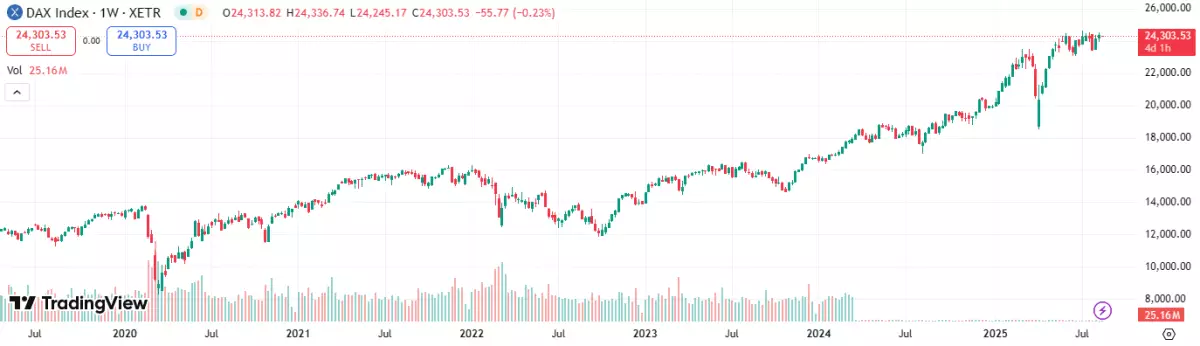
The DAX (Deutscher Aktienindex) is the headline German index and the one the media follow most. It brings together the 40 largest and most liquid German corporations traded through XETRA, among them Siemens, SAP, Volkswagen and Allianz. It is what is known as a performance index, meaning its value also reflects reinvested dividends. That sets it apart from most world indices and gives a truer picture of the total return on an investment.
The MDAX follows on from the DAX and covers 50 mid-cap companies ranking immediately below the DAX constituents by size. It is treated as a barometer of the German Mittelstand, the country’s powerful mid-sized business sector.
The TecDAX is a specialised index tracking the 30 most significant German technology firms. It serves as the benchmark for the German tech sector.
The main companies listed in Frankfurt
Unlike some venues that are narrowly specialised, the FWB hosts vast, well-established corporations from every core area of the German economy.
The industrial and automotive giants are the undoubted mainstay of the market. This group takes in leading global conglomerates and vehicle makers such as Siemens (SIE), Volkswagen Group (VOW3), Mercedes-Benz Group (MBG) and BMW (BMW), along with the chemical majors BASF (BAS) and Bayer (BAYN).
The second pillar is finance and insurance. The best-known names include Allianz (ALV), one of the world’s largest insurers, and financial houses such as Deutsche Bank (DBK) and the reinsurer Munich Re (MUV2).
The technology sector is strongly represented too, above all by the software giant SAP (SAP), Europe’s largest software company. Alongside it stand the chipmaker Infineon Technologies (IFX) and the logistics colossus Deutsche Post (DHL). Firms from renewables, healthcare and consumer goods are also growing in importance, among them the sportswear and footwear maker Adidas (ADS).
The most valuable shares on the German exchange
The seven largest German listings by market capitalisation. The order will surprise anyone who associates Germany mainly with carmakers — industry, software and insurance sit at the top, while Mercedes, BMW and Volkswagen are today an order of magnitude smaller.
| Company | Price | Change | Change % | Market cap |
|---|---|---|---|---|
 Siemens Siemens | 157,51 USD | -2,48 USD | −1,55 % | 241,14 mld. USD |
 SAP SAP | 209,63 USD | -1,23 USD | −0,58 % | 241,95 mld. USD |
 Allianz Allianz | 47,24 USD | -0,74 USD | −1,54 % | 179,17 mld. USD |
 Deutsche Telekom Deutsche Telekom | 29,67 USD | -0,25 USD | −0,84 % | 141,90 mld. USD |
 Siemens Energy Siemens Energy | 32,31 USD | -0,86 USD | −2,59 % | 137,45 mld. USD |
 Infineon Infineon | 67,48 USD | +0,33 USD | +0,49 % | 87,69 mld. USD |
 Munich Re Munich Re | 11,39 USD | -0,09 USD | −0,78 % | 71,65 mld. USD |
Quotes are indicative and delayed.
Prices in the table are in dollars because we track these companies through their US ADRs. On the Frankfurt exchange the same shares trade in euros under the tickers SIE, SAP or ALV.
How to invest on the German exchange and buy shares
Buying German shares is considerably easier today than it may seem. Online brokers remove the need to open an account abroad.
The process is straightforward: once the account is funded, you look up the ticker of the company you want and place the order. Shares on the FWB trade in euros and most platforms let you hold the account in several currencies, which smooths the whole thing out.
eToro is a multi-asset investment platform. The value of your investments may go up or down. Your capital is at risk.
Conclusion
The Frankfurt exchange is to Europe what New York is to the United States: the place where an industrial past meets a digital present. XETRA turned it into a fully electronic market in 1997, and the DAX is now the first number anyone checks who wants to know how the German economy is doing.
For an investor abroad the practical point is that getting there is as easy as reaching the US markets — and that the composition of the top of the market is not what they would expect. Germany’s most valuable companies no longer make cars.