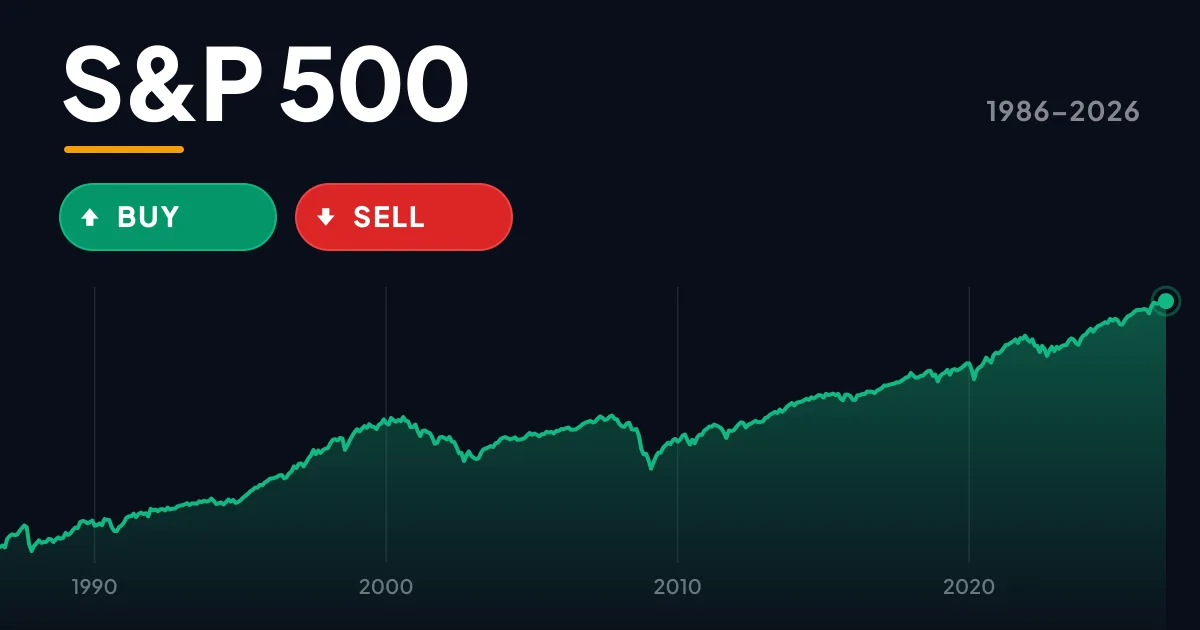
The S&P 500 is the most watched gauge of the US stock market, and buying a fund that tracks it month after month is one of the most common investment decisions anyone makes. The practical side is where it gets messy — choosing the fund, paying the broker, and dealing with the currency you buy in.
What the S&P 500 index is
The S&P 500 tracks 500 large US companies. It is not a plain ranking of the five hundred biggest firms — a candidate has to meet conditions such as a listing on a US exchange, sufficient liquidity, a large enough free float and profitability, and the final call rests with the index committee at S&P Dow Jones Indices. Because a handful of firms have two share classes in the index, the number of securities runs slightly above 500. Funds that use physical replication hold 504 positions.
The weights are not equal. Each company sits in the index according to its float-adjusted market capitalisation, so the largest names move the index far more than the ones at the bottom of the list. “Five hundred companies across every sector” therefore does not mean risk spread evenly — we went through the numbers in the article on the companies with the largest weight in the S&P 500.
The line-up keeps changing. Companies that stop meeting the criteria leave and others take their place. Nothing is required of the investor. The fund makes the swap.
What the S&P 500 has returned over time
From 1926 to the middle of 2026 the S&P 500 returned roughly 10.5% a year, measured as a compound return in dollars with dividends reinvested. Strip out inflation and about 7.3% a year is left. Without dividends, from the price move alone, around 6.5% a year. We break those three numbers down in our guide to the actual average annual return of the S&P 500.
An average says nothing about any single year. Over the ten years to the end of 2025 the index returned 14.82% a year with dividends reinvested, yet 2022 alone finished down more than 18%.
For a European retail investor there is a second moving part. The index return is quoted in dollars, so a euro account moves with the index and with EUR/USD at the same time.
Why US-listed ETFs are not sold in Europe
English-language material on the S&P 500 almost always points to three tickers: SPY (SPDR S&P 500 ETF Trust), VOO (Vanguard S&P 500 ETF) and IVV (iShares Core S&P 500 ETF). All three are domiciled in the United States, and a retail investor in Europe cannot buy them through a European broker.
The obstacle is not their absence from European exchanges. It is the PRIIPs regulation, in force since 1 January 2018, which requires the seller to hand a retail investor a key information document (KID) before the trade. US issuers do not produce one, so brokers operating in Europe block the purchase outright. Interactive Brokers spells it out in its terms: with no KID available, the broker has to disable trading in that product. DEGIRO says the same and adds that positions bought before 2018 can still be held and sold. They just cannot be topped up.
There is only one reliable route to the US funds — asking your broker to reclassify you as a professional client under MiFID II. That means meeting at least two of three criteria, one of which is a portfolio of financial instruments and cash deposits above €500,000, and giving up part of the protection retail clients enjoy. For €80 a month it makes no sense.
European ETFs tracking the S&P 500
You recognise the European counterpart by UCITS in the name and by an ISIN starting with IE (Ireland) or LU (Luxembourg). Every fund in the table follows the same index. They differ in cost, in what they do with dividends and in how they replicate it.
| Fund | ISIN | TER p.a. | Dividends | Replication |
|---|---|---|---|---|
| SPDR S&P 500 UCITS ETF (Acc) – SPYL | IE000XZSV718 | 0.03% | accumulates | physical |
| SPDR S&P 500 UCITS ETF (Dist) – SPY5 | IE00B6YX5C33 | 0.03% | pays quarterly | physical |
| iShares Core S&P 500 UCITS ETF – CSPX, SXR8 | IE00B5BMR087 | 0.07% | accumulates | physical |
| Vanguard S&P 500 UCITS ETF (Acc) – VUAA | IE00BFMXXD54 | 0.07% | accumulates | physical |
| Vanguard S&P 500 UCITS ETF (Dist) – VUSA | IE00B3XXRP09 | 0.07% | pays quarterly | physical |
| Invesco S&P 500 UCITS ETF – SPXS | IE00B3YCGJ38 | 0.05% + 0.07% swap | accumulates | synthetic |
Figures come from the issuers’ key information documents and factsheets, as of August 2026.
Invesco splits its fee in two. The factsheet lists an ongoing charge of 0.05% and a separate swap fee of 0.07%, with a note that the total cost is the sum of both. The fund therefore costs 0.12% a year, not 0.05%.
Search for the fund by ISIN, not by ticker. The same fund carries a different code on every exchange, and often a different currency too. The iShares Core S&P 500 UCITS ETF trades on Frankfurt’s Xetra as SXR8 in euros, in London as CSPX in dollars and as CSP1 in pounds, and in Milan as CSSPX in euros. It is still one fund with one ISIN, just ten listings on different exchanges.
Physical or synthetic replication
A physical fund actually buys the shares in the index. A synthetic one does not hold them. Instead it contracts with a counterparty for the index return. Tracking tends to be slightly tighter, because the swap delivers the index return without the dividend leakage a physical fund cannot avoid, but it adds the risk that the counterparty fails to deliver. Most European S&P 500 funds are physical, and Invesco is the only synthetic one in the table above.
Accumulating or distributing
The difference lies in what the fund does with the dividends paid by the companies in the index.
The accumulating class reinvests them back into the fund. The value of your holding grows and no cash arrives that you would have to reinvest manually and pay for the trade again.
The distributing class sends the dividends to your account as cash. That suits an investor who wants regular income from the portfolio.
The pairs in the table above are the same fund in two share classes, so choosing between SPYL and SPY5, or between VUAA and VUSA, comes down to this and nothing else.
What it actually costs
A fund’s running cost goes by the abbreviation TER (Total Expense Ratio). It is not a fee you pay separately — it is deducted continuously from the fund’s assets, so it never appears on your statement. We break it down in the article on ETF holding costs and fees.
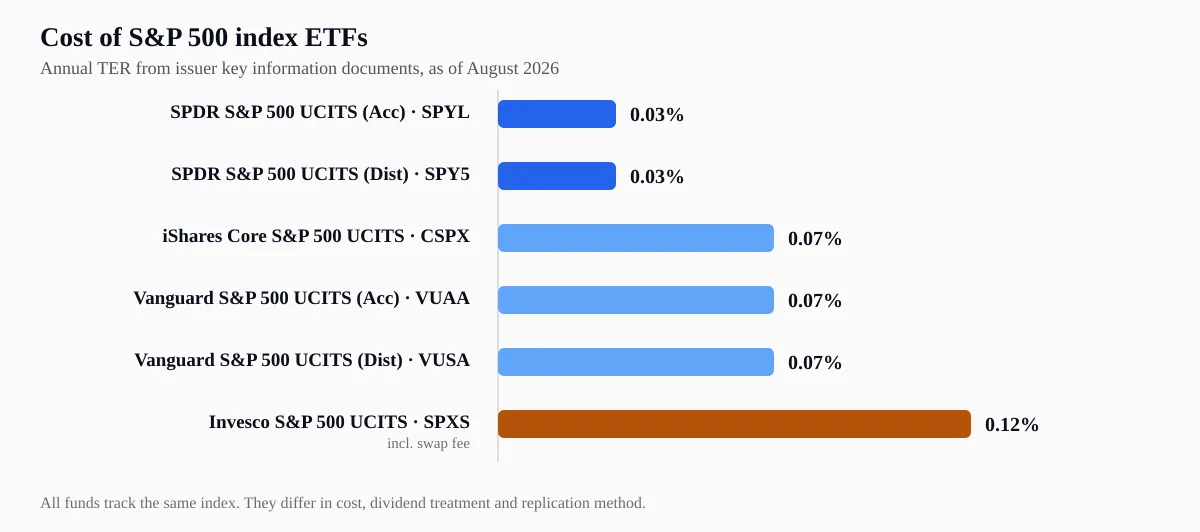
Cost of funds tracking the same index. Source: issuer key information documents and factsheets.
Actively managed equity funds cost an order of magnitude more, and the gap repeats every year you hold the fund.
On small regular purchases, TER is not even the biggest cost.
Lump sum or regular purchases
Investing the same amount at regular intervals, known as DCA (dollar cost averaging), spreads your purchase price over time. When the market falls, the same money buys more units. When it rises, it buys fewer. The method does not rest on guessing the right moment to buy, which is why it suits a beginner better than an attempt at timing.
When the market rises over the period in question, a lump sum invested at the start earns more, because the regular purchases go in at progressively higher prices.
Regular buying does not have to be manual. XTB offers Investment Plans with automated payments on a daily, weekly or monthly schedule. eToro offers recurring investments from $25 a month.
The S&P 500 has repeatedly lost double-digit percentages of its value, and the return to the previous high took years. Anyone who will need the money in two years should not have it in an equity fund. Before you start, keep a cash reserve for everyday expenses somewhere else.
Where to buy the ETF
Buying an ETF is commission-free at both XTB and eToro. XTB charges no commission up to a cumulative monthly turnover of €100,000 across all accounts, 0.2% with a €10 minimum above that limit, sets no minimum deposit, and lets you hold the account in euros. eToro is commission-free on ETFs regardless of order size and also holds euros, so a euro deposit arrives without conversion, but moving that balance into a dollar position costs 0.75%. Withdrawing from the dollar balance costs $5, with a $30 minimum withdrawal.
An unleveraged ETF purchase with eToro means you own the units. Leveraged and short positions are CFDs.
eToro is a multi-asset investment platform. The value of your investments may go up or down. Your capital is at risk.
Other routes to the index
An index mutual fund. It does the same job as an ETF but does not trade on an exchange. You buy units directly from the manager at a price set once a day. Watch out for a common mix-up: a mutual fund does not imply active management and an ETF does not imply passive. The Vanguard 500 Index Fund is a mutual fund that merely tracks the index, while actively managed ETFs now number in the hundreds.
Individual shares from the index. In theory you can assemble the index yourself. In practice that would mean holding more than five hundred names in the right proportions and rebalancing them at every index change. Neither the cost nor the effort is worth it. Buying a few of the largest companies in the index is a different thing from buying the index.
Derivatives on the index. Futures and CFDs follow the index move, but they buy you no shares. They are leveraged instruments built for short-term speculation rather than long-term holding, and losses multiply exactly as gains do.
The version without US companies is covered in the article on world ETFs without US shares.
Common questions
How much money do you need to start?+
It depends on the broker, not on the index. XTB sets no minimum deposit and the smallest stock order is €10. eToro states a minimum first deposit between $10 and $10,000 depending on the country, and at least $50 for every deposit after that. Check the figure for your own country of residence with the broker before you open the account.
Which S&P 500 ETF is the cheapest?+
Among the physically replicated funds available to a European investor, SPDR SPYL and SPY5 are the cheapest at 0.03% a year. Against a fund charging 0.07%, the gap on a €4,000 investment is €1.60 a year, so cost alone should not decide it — fund size and whether your broker offers the line at all count as well.
Does buying in euros remove the currency risk?+
No. The fund holds US shares and its value is calculated in dollars, so you carry the dollar even when you paid for the units in euros. The only way to remove it is a currency-hedged share class, such as the iShares S&P 500 EUR Hedged UCITS ETF (IE00B3ZW0K18), which costs 0.20% instead of 0.07% and shifts the risk from the dollar to the euro rather than removing it.
What is the difference between a mutual fund and an ETF?+
An ETF is bought on an exchange during the trading day like a share, while units of a mutual fund are bought directly from the manager at a price set once a day. Index funds are cheap because no team of analysts picks the stocks behind them, not because they trade on an exchange.
What should you do when the market falls?+
A fall on its own changes nothing. The loss becomes real only when you sell at the bottom.