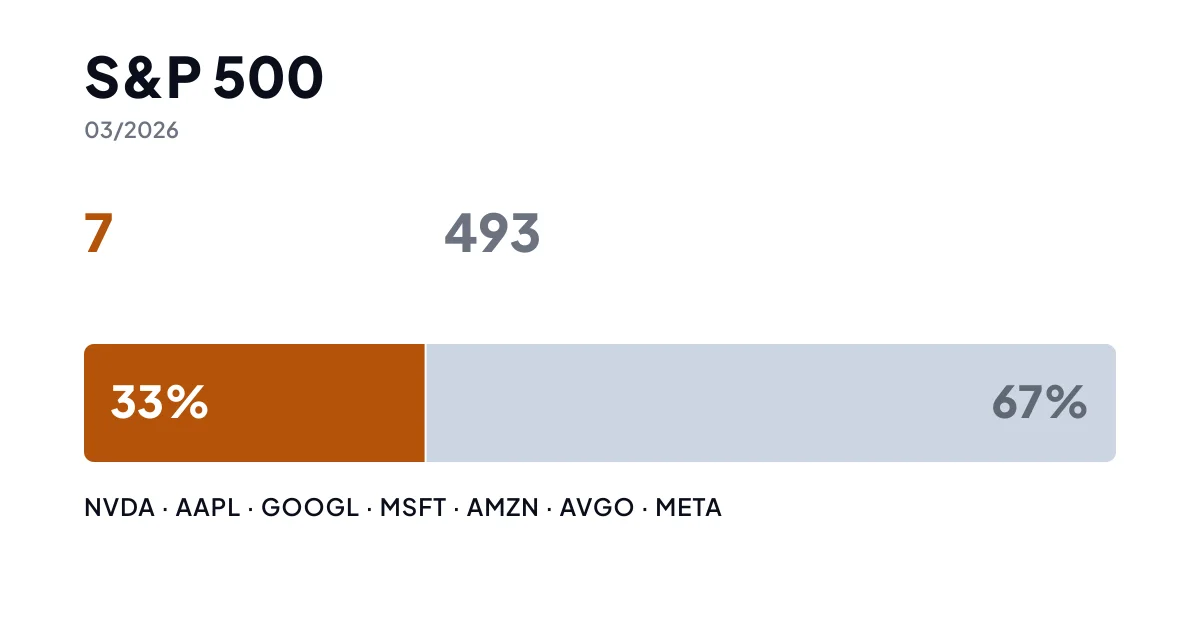
The S&P 500 is sold as a bet on five hundred American companies. In reality, a third of it is a bet on seven of them. The other four hundred and ninety-three split what is left.
The concentration is not new, but over the past two years it has deepened and, above all, reshuffled inside. The order that held at the end of 2024 no longer holds even in first place.
The seven companies that carry the index
The table shows current market capitalisation, the total value of all of a company’s shares. That is the figure the index weight is calculated from — and unlike a percentage share, it can be shown live.
| Company | Market cap |
|---|---|
 NVIDIA NVIDIA | 5,55 bil. USD |
 Apple Apple | 4,91 bil. USD |
| Alphabet (Google) | 4,30 bil. USD |
 Microsoft Microsoft | 3,85 bil. USD |
 Amazon Amazon | 2,70 bil. USD |
 Broadcom Broadcom | 1,69 bil. USD |
 Meta (Facebook) Meta (Facebook) | 1,86 bil. USD |
Quotes are indicative and delayed.
Together these companies are worth around 24 trillion dollars. For scale, that is roughly five times the annual output of the German economy.
The gaps inside the seven are enormous. NVIDIA on its own is bigger than Broadcom and Meta combined. Talking about “seven big companies” as one group therefore distorts the picture quite a lot.
Why Alphabet goes missing from lists like this
Alphabet slips out of rankings of the largest companies easily. The reason is a technicality in how the index carries its shares.
Alphabet, the parent company of Google, has two share classes on the market: GOOGL with voting rights and GOOG without. The index treats them as two separate entries, each with a weight of about three percent. Anyone building a ranking from the weighting table and taking the first seven rows either misses Alphabet entirely or counts only one half of it.
But it is one company. Add both classes together and Alphabet is the third largest company in the index, one of three firms worth more than four trillion dollars.
Berkshire Hathaway is a similar case with its A and B classes, only on a smaller scale.
What weight in the index actually means
The S&P 500 is weighted by market capitalisation. A company’s weight is therefore not a reward for quality or a decision by some committee — it is simply its share of the combined value of every company in the index.
In practice that means two things.
First: buy an index fund for a thousand dollars and roughly three hundred and thirty of it goes into those seven companies, about seventy into NVIDIA alone. The remaining four hundred and ninety-three companies split the rest, with the smallest of them getting something on the order of a dollar.
Second: the weights reshuffle themselves. Nobody adjusts them, they move with share prices on every trading day. If NVIDIA shares fall by a tenth, its weight falls with them and the index drops about seven tenths of a percent on that alone.
That is why you will not find a table of weights with exact percentages tied to one date in this text. Such a table stops being usable within a few quarters.
How much it changed in a year and a half
Set against the order from the end of 2024, the top of the index has reshuffled fast:
- NVIDIA moved from third place to first and is now the largest company in the index.
- Microsoft fell from second place to fourth, even though its value grew.
- Alphabet did not appear in that earlier ranking at all, today it is third.
- Tesla was sixth and is now eighth, outside the seven.
- Broadcom moved from seventh place to sixth.
So in a year and a half not one of the seven companies held its position, one fell out of the ranking and another joined it. That is a good reason not to read any such list as a permanent state of affairs.
How to invest in the index
The simplest route is an index fund. A European investor cannot buy American ETFs directly, though; European PRIIPS regulation stands in the way, requiring the fund to provide a key information document in the European format.
The answer is European UCITS funds that track the same index and trade normally on European exchanges. They include iShares Core S&P 500 UCITS ETF (CSPX or IUSA), Vanguard S&P 500 UCITS ETF (VUSA) and Xtrackers S&P 500 UCITS ETF. They trade on Xetra, on Euronext or in London, in euros as well as dollars.
When choosing, look mainly at the total cost. With an index this large and liquid there is no reason to pay more than two tenths of a percent a year.
The second option is to buy the shares of those companies one by one and build your own miniature of the top of the index. That means seven purchases instead of one and no fund fee, but you have to keep track yourself of when the line-up changes.
eToro is a multi-asset investment platform. The value of your investments may go up or down. Your capital is at risk.
For short-term speculation there are also CFD contracts, where you pay to hold the position overnight and do not own the underlying share.
Conclusion
Seven companies, a third of the index. The number is interesting in itself, but it is more useful to know how unstable that line-up is: in a year and a half almost half the order changed and one company from the original seven fell out completely.
Anyone buying the S&P 500 is buying mainly this top group — and with it the fact that it is more technological today than it has ever been. Anyone who wants a less concentrated portfolio has to reach for an equal-weight index or for the broader market. The S&P 500 itself does not solve that concentration, it measures it.
The market capitalisation figures in the table load live. The index shares are based on the composition as of March 2026; on the index’s long-term returns we write in the text about the average annual return of the S&P 500.