Under the label “defense stocks” sits a company that builds nuclear submarines and an online store where Americans buy shotguns. The lists put both side by side, even though their shares move on completely different things — one on government budgets, the other on how many people go to the shooting range at the weekend.
Splitting the field by what a company actually makes therefore says more than one long list. Drones, underwater robots, aircraft, ground vehicles, electronics and services are six different businesses carrying six different risks.
The biggest names in the field
The starting point is five names that even an outsider knows. They are the prime contractors: they win the big military orders, and most of the smaller companies listed below work for them as subcontractors.
Lockheed Martin is the largest defense company in the world and stands on the F-35 fighter, the HIMARS rocket launchers and the PAC-3 interceptors. RTX has the Patriot missiles and aircraft engines. Northrop Grumman builds the B-21 bomber and intercontinental missiles. General Dynamics the Abrams tanks and Virginia-class submarines. Britain’s BAE Systems the Bradley fighting vehicles, howitzers and submarines for the Royal Navy.
What they share is that they are slow and predictable. Orders run years ahead, revenue depends on government budgets, and all five pay a dividend. These are not stocks where anyone waits for a double within a year.
| Company | Price | Change | Change % | Market cap |
|---|---|---|---|---|
 Lockheed Martin Lockheed Martin | 512,16 USD | -0,05 USD | −0,01 % | 118,20 mld. USD |
 Raytheon Technologies Raytheon Technologies | 187,37 USD | +0,43 USD | +0,23 % | 252,52 mld. USD |
 Northrop Grumman Northrop Grumman | 486,86 USD | -17,75 USD | −3,52 % | 69,16 mld. USD |
 General Dynamics General Dynamics | 332,32 USD | -0,02 USD | −0,01 % | 89,91 mld. USD |
| BAE Systems | 104,21 USD | +1,12 USD | +1,09 % | 76,25 mld. USD |
Quotes are indicative and delayed.
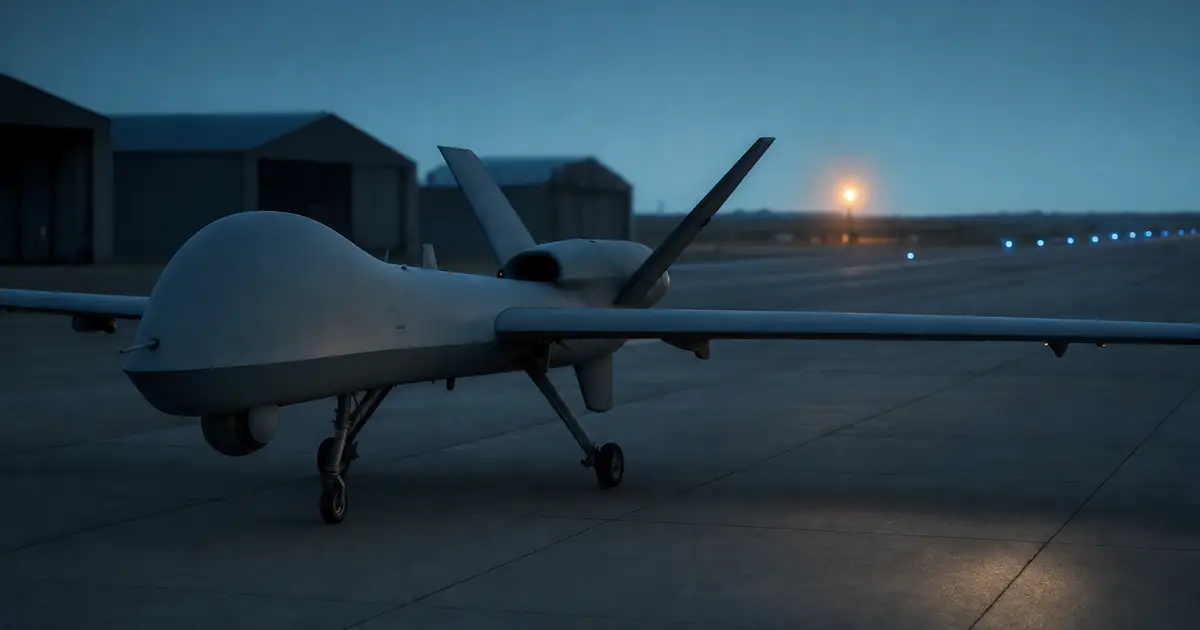
Drones
The part of the field where the most is promised.
AeroVironment supplies the US Army with the hand-launched Switchblade — which is not a classic drone but single-use loitering munition — and the Puma reconnaissance aircraft. The purchase of BlueHalo added counter-drone defense and electronic warfare, so it is no longer a pure drone company.
Elbit Systems ranks among the largest makers of reconnaissance drones in the world, and its Hermes 900 stays in the air for 36 hours. Drones are still only part of its aerospace division, and that division makes roughly a quarter of revenue. Ground systems are a similar size, and the rest is electronics, cyber and the American subsidiary.
Kratos builds cheap jets meant to fly as a “loyal wingman” alongside crewed fighters — the XQ-58A Valkyrie — and target drones. The unmanned segment has long made only about a fifth of revenue. The rest is rocket engines, microwave electronics and training.
Red Cat and Ondas are two orders of magnitude smaller. Red Cat supplies the Black Widow quadcopter to a US Army program for short-range reconnaissance, Ondas sells “drone in a box” systems for guarding sites. For both, the high growth percentages come off a negligible comparison base.
| Company | Price | Change | Change % | Market cap |
|---|---|---|---|---|
 AeroVironment AeroVironment | 144,25 USD | +1,01 USD | +0,71 % | 7,33 mld. USD |
 Elbit Systems Elbit Systems | 683,02 USD | -20,35 USD | −2,89 % | 32,01 mld. USD |
 Kratos Defense & Security Solutions Kratos Defense & Security Solutions | 43,78 USD | +0,73 USD | +1,70 % | 8,21 mld. USD |
 Red Cat Holdings Red Cat Holdings | 6,55 USD | +0,10 USD | +1,47 % | 999,52 mil. USD |
| Ondas Holdings | 7,49 USD | +0,01 USD | +0,07 % | 4,36 mld. USD |
Quotes are indicative and delayed.
Smaller still are Draganfly and AgEagle — nano-caps whose orders run in single units and go to emergency services and agriculture rather than to the military.
Counter-drone systems
A field of its own, grown out of cheap drones becoming a problem. DroneShield makes the hand-held DroneGun jammers and stationary systems that find hostile drones and cut them off from their signal. Leonardo DRS supplies the MHR radar, which looks for small targets low above the ground.
| Company | Price | Change | Change % | Market cap |
|---|---|---|---|---|
| DroneShield | 1,25 USD | +0,08 USD | +6,84 % | — |
| Leonardo DRS | 37,02 USD | +0,29 USD | +0,79 % | 9,88 mld. USD |
Quotes are indicative and delayed.
Underwater robots
Torpedo-shaped machines that survey the seabed on their own, hunt for mines or track submarines. The market is small and it is almost always just one piece of a large company.
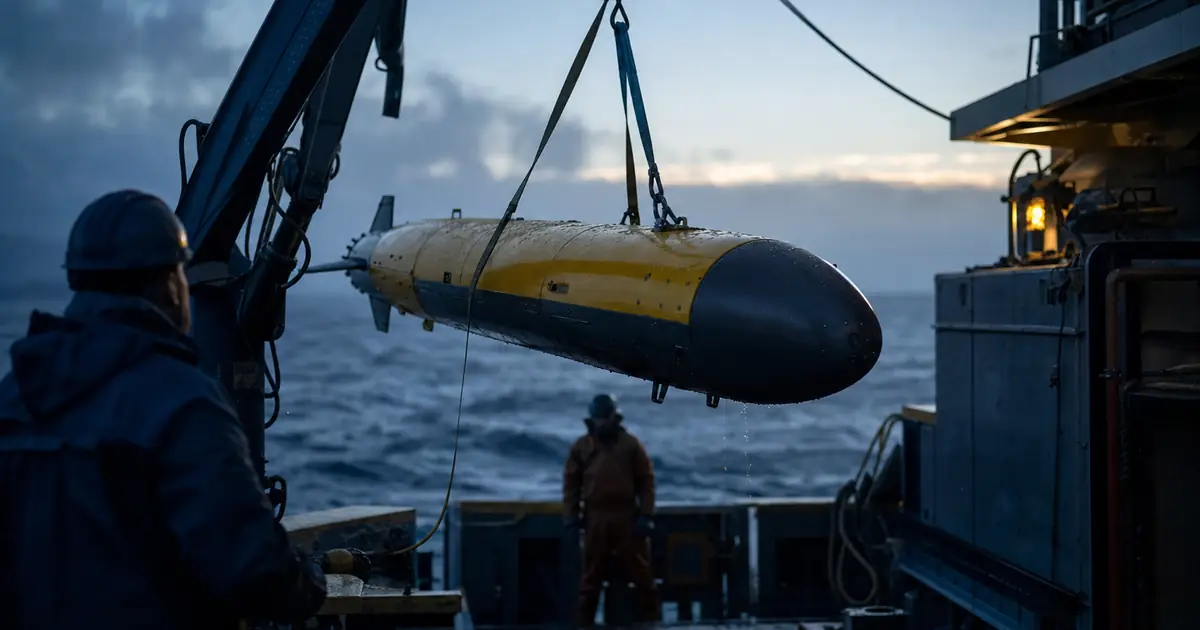
Huntington Ingalls is the largest American shipyard: it builds aircraft carriers and Virginia-class submarines, and in its Mission Technologies division also the REMUS family of underwater vehicles. Classic shipbuilding accounts for about three quarters of revenue, though, and the robots are a small item.
Kongsberg has the autonomous HUGIN vehicle, but the main business is the Naval Strike Missile anti-ship missiles, the NASAMS air defense system and remotely operated weapon stations.
Saab makes the AUV62 and Sabertooth underwater vehicles and the electric Seaeye robots, while its revenue is driven by the Gripen fighter and the Carl-Gustaf anti-armor weapon.
Teledyne owns the Slocum underwater gliders and the Gavia vehicles, but more than half of revenue comes from cameras and sensors.
Oceaneering runs the largest fleet of working underwater robots in the world, in the order of hundreds of units. Mostly for oil platforms, though, not for the military — the defense and space division makes only about a sixth of revenue. It is more a bet on the oil price than on defense budgets.
| Company | Price | Change | Change % | Market cap |
|---|---|---|---|---|
 Huntington Ingalls Industries Huntington Ingalls Industries | 264,76 USD | +5,12 USD | +1,97 % | 10,43 mld. USD |
| Kongsberg Gruppen | 16,50 USD | +0,37 USD | +2,29 % | 29,03 mld. USD |
| SAAB | 30,80 USD | +0,15 USD | +0,49 % | 33,18 mld. USD |
 Teledyne Teledyne | 609,27 USD | +3,68 USD | +0,61 % | 28,23 mld. USD |
 Oceaneering International Oceaneering International | 44,51 USD | +0,29 USD | +0,66 % | 4,43 mld. USD |
Quotes are indicative and delayed.
eToro is a multi-asset investment platform. The value of your investments may go up or down. Your capital is at risk.
Aircraft and missiles
The heaviest calibre of the sector, where one order runs for decades.
By program, the whole trio from the opening belongs here — Lockheed Martin, Northrop Grumman and RTX, whose F135 engine powers the F-35 itself.
Boeing is often put on the list whole, even though roughly a third of its revenue comes from the US government — the rest is airliners. Safran supplies engines and equipment and takes just under a fifth of revenue from military work. Leonardo is to a large extent a helicopter maker whose machines also fly for air ambulances, and the Italian state holds a third of the shares.
Dassault Aviation builds the Rafale but gets roughly half of its revenue from the civilian Falcon business jets. In the US it also trades only through an unsponsored ADR over the counter, where liquidity is minimal.
| Company | Price | Change | Change % | Market cap |
|---|---|---|---|---|
| Lockheed Martin | 512,16 USD | -0,05 USD | −0,01 % | 118,20 mld. USD |
| Northrop Grumman | 486,86 USD | -17,75 USD | −3,52 % | 69,16 mld. USD |
| Raytheon Technologies | 187,37 USD | +0,43 USD | +0,23 % | 252,52 mld. USD |
 Boeing Boeing | 187,97 USD | +0,29 USD | +0,15 % | 148,46 mld. USD |
 Safran Safran | 94,65 USD | -0,55 USD | −0,58 % | 156,88 mld. USD |
 Leonardo Leonardo | 27,77 USD | +0,01 USD | +0,04 % | 32,04 mld. USD |
 Dassault Aviation Dassault Aviation | 330,00 USD | -4,23 USD | −1,27 % | 25,43 mld. USD |
Quotes are indicative and delayed.
Ground vehicles
Tanks, armoured vehicles and artillery ammunition — the part of the field the war in Ukraine moved the most.
Rheinmetall makes the gun for the Leopard 2 tank, the Boxer and Puma armoured vehicles and above all 155 mm ammunition. General Dynamics has, alongside Abrams and the Virginia submarines, the Gulfstream division, that is luxury business jets — defense is not the whole company. At BAE Systems it is specifically the Bradley fighting vehicles and the M109 howitzers.
Oshkosh is on the lists out of inertia: the JLTV armoured vehicle was its flagship, but it lost the competition for continued production in 2023, and most of its revenue comes from access platforms and utility vehicles.
| Company | Price | Change | Change % | Market cap |
|---|---|---|---|---|
 Rheinmetall Rheinmetall | 216,98 USD | -0,84 USD | −0,39 % | 50,63 mld. USD |
| General Dynamics | 332,32 USD | -0,02 USD | −0,01 % | 89,91 mld. USD |
| BAE Systems | 104,21 USD | +1,12 USD | +1,09 % | 76,25 mld. USD |
 Oshkosh Corporation Oshkosh Corporation | 129,32 USD | -2,36 USD | −1,79 % | 8,06 mld. USD |
Quotes are indicative and delayed.
Electronics, radar and systems
Companies that do not build machines, but the things machines see and speak with.
L3Harris supplies tactical radios and, after buying Aerojet Rocketdyne, rocket motors as well. Hensoldt makes the TRML-4D radar, the eyes of the IRIS-T air defense system, which proved itself in the defense of Ukraine. Thales has the radar for the Rafale and sonars for submarines, but a large share of its revenue comes from civil avionics and payment cards. Indra is a similar case: alongside radars it runs the civilian IT division Minsait. Mercury Systems is a supplier of modules into other people’s systems — it has no program of its own and lives off what the large defense groups order.
| Company | Price | Change | Change % | Market cap |
|---|---|---|---|---|
 L3Harris Technologies L3Harris Technologies | 237,15 USD | +0,68 USD | +0,29 % | 44,16 mld. USD |
 Thales Thales | 51,06 USD | -0,26 USD | −0,51 % | 52,50 mld. USD |
 Hensoldt Hensoldt | 8,62 USD | +0,14 USD | +1,65 % | 9,96 mld. USD |
| Indra Sistemas | 33,50 USD | -0,58 USD | −1,70 % | 11,73 mld. USD |
 Mercury Systems Mercury Systems | 83,50 USD | +0,86 USD | +1,04 % | 5,08 mld. USD |
Quotes are indicative and delayed.
Services, maintenance and IT
The most overlooked part of the sector. These companies build nothing — they sell hours, software and maintenance.
Leidos lives almost entirely off government contracts, roughly half of them defense and intelligence. Booz Allen and CACI are consulting and technology firms; at both, defense contracts make more than half of revenue. Parsons does missile defense as well as roads and tunnels. V2X runs military bases and logistics. QinetiQ grew out of British military research, operates test ranges and makes the Banshee target drones.
The risk here is different from the manufacturers: it is not a program slipping, it is losing a contract in a tender.
| Company | Price | Change | Change % | Market cap |
|---|---|---|---|---|
 Leidos Leidos | 122,96 USD | -0,14 USD | −0,11 % | 15,47 mld. USD |
 Booz Allen Hamilton Booz Allen Hamilton | 70,42 USD | +0,71 USD | +1,02 % | 8,47 mld. USD |
 CACI CACI | 611,77 USD | +3,63 USD | +0,60 % | 13,52 mld. USD |
 Parsons Parsons | 41,49 USD | -0,06 USD | −0,16 % | 4,43 mld. USD |
| V2X | 73,06 USD | +0,26 USD | +0,36 % | 2,29 mld. USD |
 QinetiQ QinetiQ | 25,75 USD | -0,12 USD | −0,46 % | 3,28 mld. USD |
Quotes are indicative and delayed.
How much of it is actually defense
With the big names it pays to look at how much of the company defense really is. The exact percentages shift with every annual report, but the orders of magnitude hold:
- CACI and Booz Allen — with intelligence work, around seven tenths of revenue
- RTX — just under two fifths from the US government, and that is without military exports abroad, so the real exposure is higher
- HEICO — roughly a third
- Textron and Teledyne — around a quarter
- Honeywell — just under a fifth
- Howmet — roughly a sixth
Palantir reports more than half of its revenue in the government segment, but that one mixes defense, civilian agencies and foreign governments — the purely defense share cannot be calculated from the filing.
Companies report either a defense segment or the share of revenue from government. Figures on aggregator sites tend to be a year behind.
Companies that do not belong on the list
A few names hold on in older overviews where defense either ended or never began:
- Sturm Ruger makes rimfire rifles, revolvers and bolt-action rifles for the American civilian market. The stock reacts to gun sales and to the politics around firearms legislation, not to defense budgets.
- AMMO Inc, today Outdoor Holding Company, sold its entire ammunition production to the Olin Winchester group in April 2025. What remains is the GunBroker online marketplace.
- VSE Corporation sold the Federal & Defense division in 2024 and the Fleet division in April 2025. Today it is a distributor of aircraft spare parts for airlines.
- EHang is a Chinese maker of autonomous flying taxis. It has nothing in common with the Western defense industry and carries the risk of sanctions and delisting.
- Avon Technologies makes protective masks against chemical weapons and helmets — personal protection, not weapons.
- Axon makes tasers and body cameras for the police. It reports no defense revenue in its filings at all.
What to watch out for
ADR are not the same thing as shares. On top of the lower liquidity of unsponsored ADR come a wider spread and currency risk.
A single customer is a risk. Hensoldt runs mainly on the Bundeswehr, QinetiQ on the British Ministry of Defence. A budget change in one country rewrites the whole story.
Market values and prices in the tables are updated after each trading day.