If you want to learn more about the regulation of online trading and investing, take a look at our list of financial regulators below. The list focuses mainly on the regulators most relevant to online trading in forex, CFDs or shares, and on jurisdictions with a large number of brokers and investment firms.
Details on individual authorities can be found on their own websites. If you think we should add or change something, let us know.
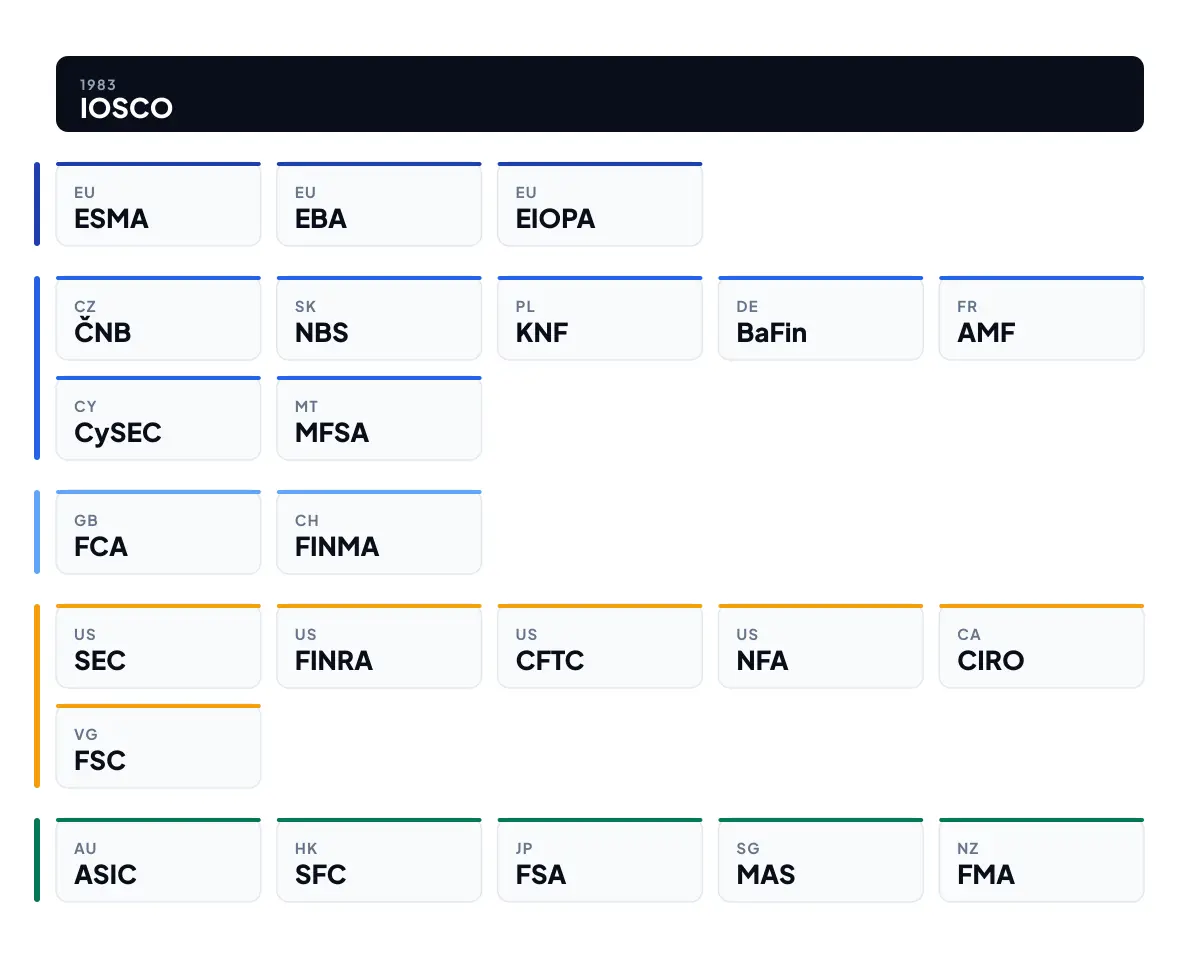
Regulators by jurisdiction. The colours distinguish European bodies, EU member states, European countries outside the EU, the Americas, and Asia and the Pacific. IOSCO brings together regulators from around the world, but it does not stand above them.
European Union
- Markets in Financial Instruments Directive II (MiFID II)
Within the European Union, national financial regulators are tasked with upholding the Markets in Financial Instruments Directive (MiFID II), which serves to harmonise financial supervision across EU member states. This directive sets rules for various aspects of how financial institutions operate, including online brokers, such as client care, order execution and transparency. Although financial institutions in the EU are regulated within their own states, they can register with other EU regulators in order to offer their services in other member states as well.
Many brokers and firms based in the European Union are not very specific when describing their regulatory status. They often present themselves as “EU regulated” or “MiFID regulated”, which can be misleading. The original MiFID directive ceased to apply on 2 January 2018, when MiFID II replaced it. Some firms overstate their position this way.
United Kingdom
- Financial Conduct Authority (FCA)
The financial regulator Financial Conduct Authority (FCA) supervises financial services in the United Kingdom. The FCA’s aim is to protect consumers, keep the industry stable and support healthy competition between financial services providers. The FCA has the powers to make rules, carry out investigations and enforce them.
This was not a mere renaming. The FCA was created on 1 April 2013 as a new body, which took over conduct supervision of firms from the split Financial Services Authority, while prudential supervision of large banks and insurers went to the Prudential Regulation Authority (PRA). After Britain left the union, a British licence no longer allows a firm to offer services in the European Economic Area, passporting between Britain and the EEA has ended. Dozens of forex brokers have their headquarters in the United Kingdom and are therefore regulated by the FCA. Fraudulent firms also invoke British regulation without any right to do so. The FCA actively publishes warnings about unauthorised firms and maintains the public register Financial Services Register, where a reader can check whether a particular firm is registered with the FCA.
Czechia
- Czech National Bank (ČNB)
The ČNB is the body that, under the Act on the Czech National Bank, supervises the entire financial market in Czechia. It covers banks, credit unions, the capital market, insurers, pension companies and their funds, bureaux de change and payment institutions.
Until 2006, supervision was fragmented across several authorities. On 1 April 2006, the ČNB unified it and took over the agenda of the Securities Commission, the Office of State Supervision in Insurance and Pension Funds and the Office for Supervision of Credit Unions. All three ceased to exist on that date.
Anyone who wants to check a particular firm will find it in the database Seznamy regulovaných a registrovaných subjektů finančního trhu, known by the abbreviation JERRS. Alongside it, the ČNB publishes Upozornění ČNB na aktivity, that is, named warnings about entities offering services without its authorisation.
Slovakia
- National Bank of Slovakia (NBS)
Since 2006, the NBS has exercised integrated supervision over banking, the capital market, insurance and pension saving. Since 2015, it has also been the consumer protection authority for the financial market.
Unlike Czechia, Slovakia adopted the euro, and so the NBS has been part of the Single Supervisory Mechanism since November 2014, under which the largest Slovak banks are supervised directly by the European Central Bank. The Czech Republic is not in this mechanism and the ČNB supervises banks itself.
The NBS keeps its public register of supervised entities under the name Subjekty finančného trhu, and warnings about unauthorised activity in the Upozornenia NBS section.
Poland
- Komisja Nadzoru Finansowego (KNF)
The KNF supervises the Polish banking sector, the capital market, insurance, the pension sector, payment institutions and electronic money institutions. On top of that, it supervises two sectors you will not find as separate categories elsewhere, namely SKOK credit unions and non-bank lending institutions.
An entity can be checked in the search tool Wyszukiwarka podmiotów. It does not cover everything, though, insurance intermediaries are kept by the KNF in separate registers.
The Polish warning list Lista ostrzeżeń publicznych is worth attention. Unlike similar lists elsewhere, it is not just a roll of suspicious firms. The KNF enters into it the criminal complaints it has filed itself and proceedings conducted ex officio, typically for carrying out banking activity or providing investment services without a licence.
France
- Autorité des Marchés Financiers (AMF)
The Autorité des Marchés Financiers (AMF) regulates participants and products on the financial markets in France. It regulates, grants authorisations, monitors and, where necessary, carries out investigations and imposes sanctions. Beyond that, it also makes sure investors receive material information and provides them with a mediation service for resolving disputes.
Germany
- Federal Financial Supervisory Authority (BaFin)
BaFin regulates all participants in the German financial markets, among them banks and other financial services providers, insurers, exchanges and stock markets, and asset managers. It watches that they comply with the rules protecting investors and the stability of the financial system. Whether a particular firm holds an authorisation can be checked by the reader in the daily updated database Unternehmensdatenbank.
Cyprus
- Cyprus Securities and Exchange Commission (CySEC)
The Cyprus Securities and Exchange Commission (CySEC) is the official supervisory body responsible for regulating investment services and securities trading in the Republic of Cyprus.
Cyprus is one of the most popular jurisdictions for setting up online forex brokers. CySEC supervises more than 200 firms, most of which specialise in trading CFDs, forex and other financial instruments.
Switzerland
- Swiss Financial Market Supervisory Authority (FINMA)
FINMA is the official government body that oversees financial regulation in Switzerland. Its powers cover the supervision of banks, insurers, exchanges and securities dealers, as well as other financial institutions in Switzerland.
The Swiss financial sector has a reputation for being strictly regulated, and that is exactly why fraudulent companies invoke it. Most of the companies on FINMA’s long list of unauthorised institutions were entered there precisely because of such practices.
Malta
- Malta Financial Services Authority (MFSA)
The MFSA is the single regulator of financial services in Malta. Its remit covers supervision of the entire financial services sector, including the activities of credit institutions, financial and electronic money institutions, securities and investment services companies, regulated markets, insurers, pension funds and administrators.
In recent years, several forex and CFD brokers have obtained an MFSA licence.
Italy
- Commissione Nazionale per le Società e la Borsa (CONSOB)
CONSOB was set up in 1974 and is the Italian securities markets authority. In that capacity it also sits on the ESMA board of supervisors.
Italy divides supervision differently from most countries on this list. It does not split it by type of institution, but by purpose, in Italian vigilanza per finalità. The same firm therefore has two supervisory bodies at once. The Bank of Italy watches over risk containment and capital stability, CONSOB over transparency and fair conduct towards clients.
For the reader, this has a practical consequence. The register of banks is not kept by CONSOB but by the Bank of Italy, and banks are allowed to provide investment services, so when checking a firm you have to look in both places. Investment firms are kept by CONSOB in the register Albo delle imprese di investimento, and it publishes warnings about unauthorised entities as Avvisi ai risparmiatori.
CONSOB also has a power you will not find elsewhere. Since July 2019 it has been able to order internet providers to block the websites of unauthorised firms. By August 2026 it had blocked 1,805 of them, 233 of which involved crypto-assets.
Spain
- Comisión Nacional del Mercado de Valores (CNMV)
The CNMV supervises the Spanish securities markets and everyone active in them. Its remit covers issues and public offerings, the exchanges in Madrid, Barcelona, Bilbao and Valencia, investment firms, collective investment funds and participatory financing platforms. Banks and other credit institutions, on the other hand, belong to the Banco de España.
Firms without an authorisation are kept by the CNMV on a list of unauthorised entities. In Spain they are called chiringuitos financieros, literally financial beach bars. Registered entities are found by the reader in the Registros Oficiales de la CNMV.
Romania
- Autoritatea de Supraveghere Financiară (ASF)
The ASF supervises three non-banking parts of the Romanian financial market, namely the capital market, insurance including intermediaries, and the private pension system. Banks do not fall under it, they belong, together with non-bank credit institutions and payment institutions, to the Banca Națională a României.
The ASF keeps the capital market in the register Registrul instrumentelor și investițiilor financiare, and publishes warnings about entities without an authorisation as Alerte investitori.
Hungary
- Magyar Nemzeti Bank (MNB)
Hungary does not have a separate supervisory authority. The former PSZÁF merged with the central bank on 1 October 2013, so supervision of the entire financial market is today carried out directly by the MNB. It covers money market and capital market institutions, pension funds, insurers and market infrastructure.
The search tool for supervised institutions is called Intézménykereső, and the MNB issues warnings for investors as Befektetői figyelmeztetések.
United States of America
The United States of America has several government agencies that supervise financial firms. Over-the-counter forex trading is regulated by the Commodity Futures Trading Commission (CFTC) and the National Futures Association (NFA), while brokers offering shares fall under the Securities and Exchange Commission (SEC) and the Financial Industry Regulatory Authority (FINRA). Contracts for difference are a different case, they may not be offered to American retail clients.
- Securities and Exchange Commission (SEC)
The SEC has the primary power to enforce federal securities laws and to regulate securities, national exchanges and options exchanges and other activities and organisations, including electronic securities markets in the United States.
- Financial Industry Regulatory Authority (FINRA)
FINRA is a non-governmental self-regulatory organisation that supervises member brokerage firms. Above FINRA itself stands the SEC.
- Commodity Futures Trading Commission (CFTC)
The CFTC is an independent agency of the United States government that regulates derivatives markets, that is futures, options and swaps. It does not regulate spot commodity trading as such.
- National Futures Association (NFA)
The NFA is a self-regulatory organisation entrusted with this task by the CFTC and operating under its supervision in the futures markets. The NFA protects investors against fraudulent activity in the commodity and futures markets.
Australia
- Australian Securities and Investments Commission (ASIC)
ASIC is Australia’s regulator of companies, markets and financial services. It regulates Australian companies, financial markets, organisations providing financial services and the professionals who trade and give advice in investments, pensions, insurance, deposit taking and credit.
A number of forex and CFD brokers targeting the Asian market are based in Australia.
Canada
In Canada the situation differs from most countries, because it does not have one national financial regulator, but one for each of its 13 provinces and territories.
The main regulators include:
- Alberta Securities Commission (ASC)
- Autorité des marchés financiers (Québec) (AMF)
- British Columbia Securities Commission (BCSC)
- Ontario Securities Commission (OSC)
Besides registering with the local regulator, Canadian securities dealers and mutual fund distributors must also be members of the Canadian Investment Regulatory Organization (CIRO). It was created on 1 January 2023 by the merger of two older organisations, IIROC and MFDA, and has carried its current name since 1 June 2023. Provincial regulators coordinate their approach in the Canadian Securities Administrators (CSA), but that is not a federal authority and has no enforcement power of its own, each province keeps that itself.
British Virgin Islands
- Financial Services Commission (FSC)
The Financial Services Commission in the British Virgin Islands is the sole regulatory body for financial services in the territory. Its task is to grant authorisations and licences to companies or persons for carrying out business activities in financial services and to monitor the area of regulated activity in financial services with the aim of protecting the public against any illegal or unauthorised conduct of financial services business within the British Virgin Islands.
Among offshore jurisdictions, the rules in the British Virgin Islands are among the stricter ones.
Hong Kong
- Securities and Futures Commission (SFC)
The SFC is an independent statutory body that regulates securities and futures in Hong Kong’s markets. It works to ensure the orderly operation of the securities and futures markets and protects investors. It is one of Hong Kong’s four financial regulators, alongside the monetary authority, the insurance authority and the pension schemes authority.
International
- International Organization of Securities Commissions (IOSCO)
The International Organization of Securities Commissions (IOSCO) was founded in 1983 and is a recognised global body that brings together securities regulators from around the world. It issues international standards for securities regulation and works with the G20 and the Financial Stability Board (FSB).
IOSCO membership covers more than 99 percent of the world’s securities and derivatives markets in more than 130 jurisdictions. There are 134 ordinary members, that is national regulators, plus 34 associate and 77 affiliate members, among them exchanges and self-regulatory organisations.
Japan
- Financial Services Agency (FSA)
The FSA is tasked with supervising banking, securities, exchanges and insurance in Japan with the aim of keeping the country’s financial system stable.
In Japan, forex and CFD trading is very strictly regulated, similarly to the United States. The FSA keeps a public list of firms that approach clients with cold calls.
Singapore
- Monetary Authority of Singapore (MAS)
MAS (the central bank of Singapore) is an integrated supervisory body that oversees all financial institutions in Singapore, including banks, insurers, capital market intermediaries, financial advisers and exchanges.
New Zealand
- Financial Markets Authority (FMA)
The FMA enforces the laws on securities, financial reporting and company law that apply to financial services and markets. It also regulates securities exchanges, financial advisers and brokers, trustees, including KiwiSaver and pension fund trustees, and auditors of issuers.
Anyone offering derivatives, that is contracts for difference or leveraged forex, to New Zealand retail clients must hold a derivatives issuer licence from the FMA under the Financial Markets Conduct Act 2013. This applies to firms based outside New Zealand too.
Entry in the Financial Service Providers Register does not replace a licence on its own, it is only a registration. Older texts often claim that this entry is all a New Zealand broker needs. That matches the situation before the act took effect, not today.