A rule change that would put triple-leveraged Bitcoin and Ethereum funds on a US exchange is now sitting in front of the Securities and Exchange Commission. Cboe BZX Exchange filed it on 10 August 2026, and the SEC published it on 14 August 2026 as Release No. 34-106137, file number SR-CboeBZX-2026-065.
What is in the filing
The filing covers six funds from the VS Trust series: 3x Gold, 3x Silver, 3x Bitcoin, 3x Ether, 3x Crude Oil and 3x Natural Gas ETFs. The sponsor is Volatility Shares LLC of Palm Beach Gardens, Florida. Each fund targets three times the daily performance of its underlying before fees, and the document states that separately for all six.
Neither crypto fund would hold Bitcoin or Ethereum itself. Both would hold first- and second-month futures on CME, plus cash and cash equivalents. Contracts roll over five trading days, moving roughly 20% of positions each day, and the roll starts on the sixth business day before the nearest contract expires. Shares would be created and redeemed in blocks of 10,000.
The six funds do not meet the BZX listing standard in Rule 14.11(e)(4)(F), which keeps leveraged products off the exchange. Cboe is therefore asking to list them by exception under Section 19(b) of the Securities Exchange Act of 1934.
The attempt that stalled in 2025
Volatility Shares tried this once already. Between 14 October and 21 November 2025 the trust filed registrations with the SEC for 72 leveraged funds, 30 of them at 3x and 42 at 5x, with a 3x Bitcoin ETF and a 3x Ether ETF among them.
That batch stopped at the regulator. On 2 December 2025 the SEC’s Division of Investment Management wrote to the trust’s counsel that it would not review the filings on the merits until the questions raised had been settled.
The legal knot is rule 18f-4 under the Investment Company Act of 1940. It says a fund’s risk, measured by value at risk must not exceed 200% of the risk of a designated reference portfolio.
On 28 and 29 January 2026 the trust withdrew 45 filings, 38 of them leveraged funds. The 3x Bitcoin and 3x Ether registrations were not among the withdrawals.
Three times the day is not three times the year
The target written into the filing is one day’s move, not a month’s or a year’s. A fund built that way resets its exposure at the end of each session, so any longer holding period compounds a chain of daily multiples instead of multiplying the total move by three.
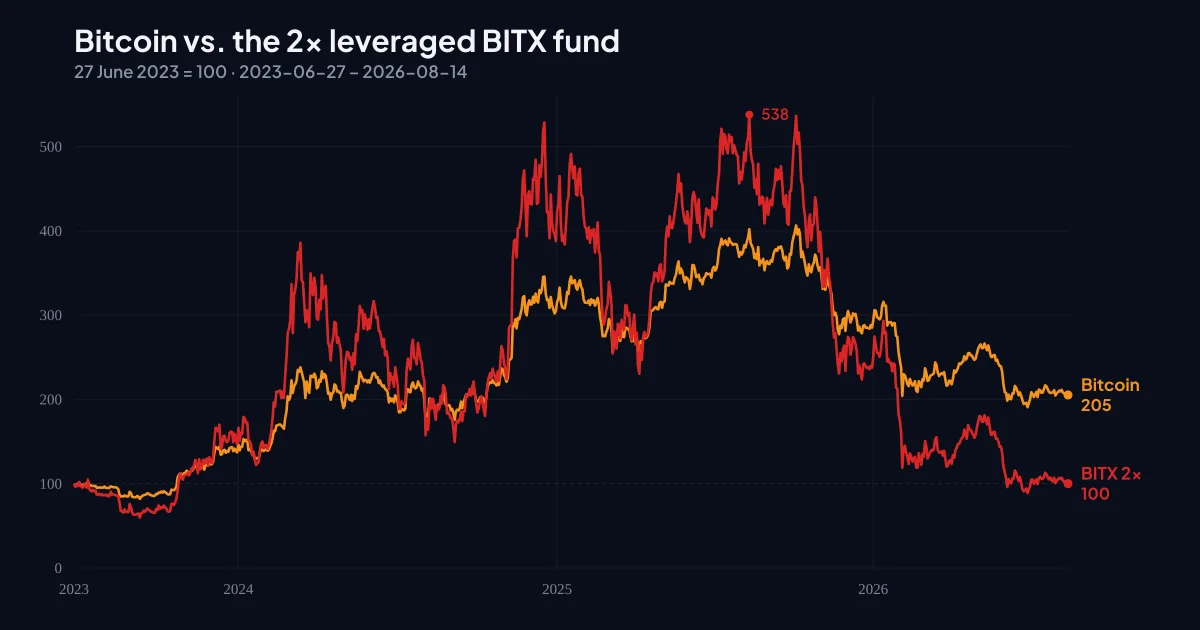
The two-times funds already on the market show how far those two numbers can drift apart. Bitcoin gained 105% between 27 June 2023, the day the 2x BITX started trading, and 14 August 2026, according to our own calculation from exchange data. Double the move would have meant roughly 210% over that stretch. The BITX share price instead fell 25% across the same two dates, again our own calculation. The fund distributed $11.69 per share in 27 payments over that period, so a holder who reinvested every one of them was roughly back at break-even on 14 August 2026. The figure moves with the closing date, which is why it belongs with the date attached.
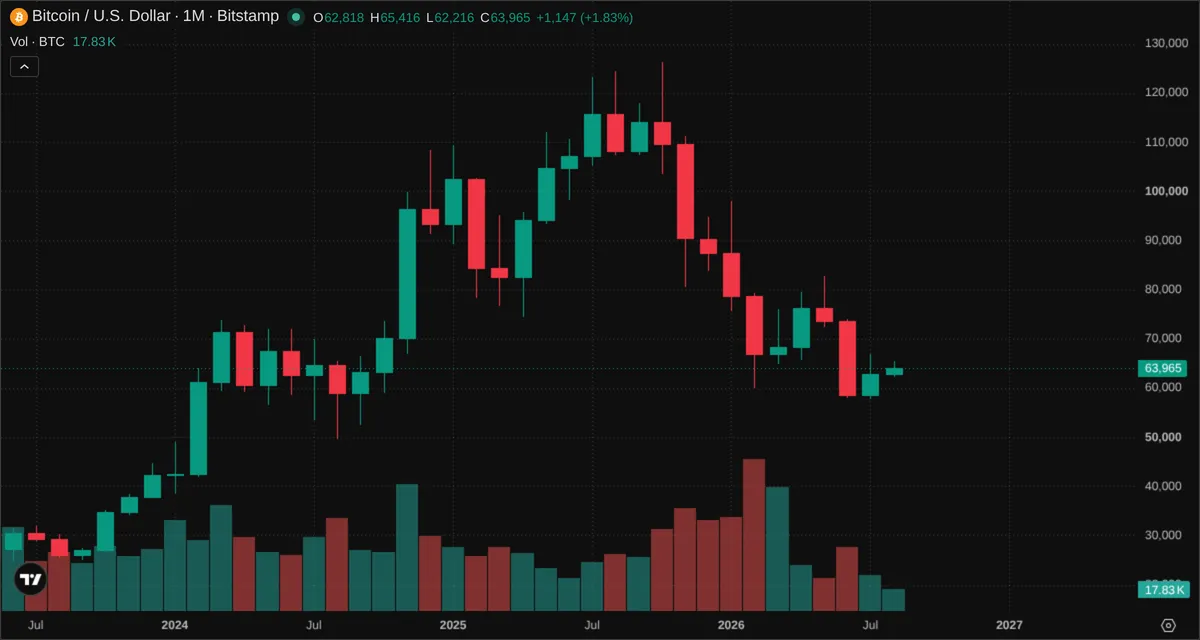
Bitcoin without leverage, monthly candles from July 2023. Source: TradingView.
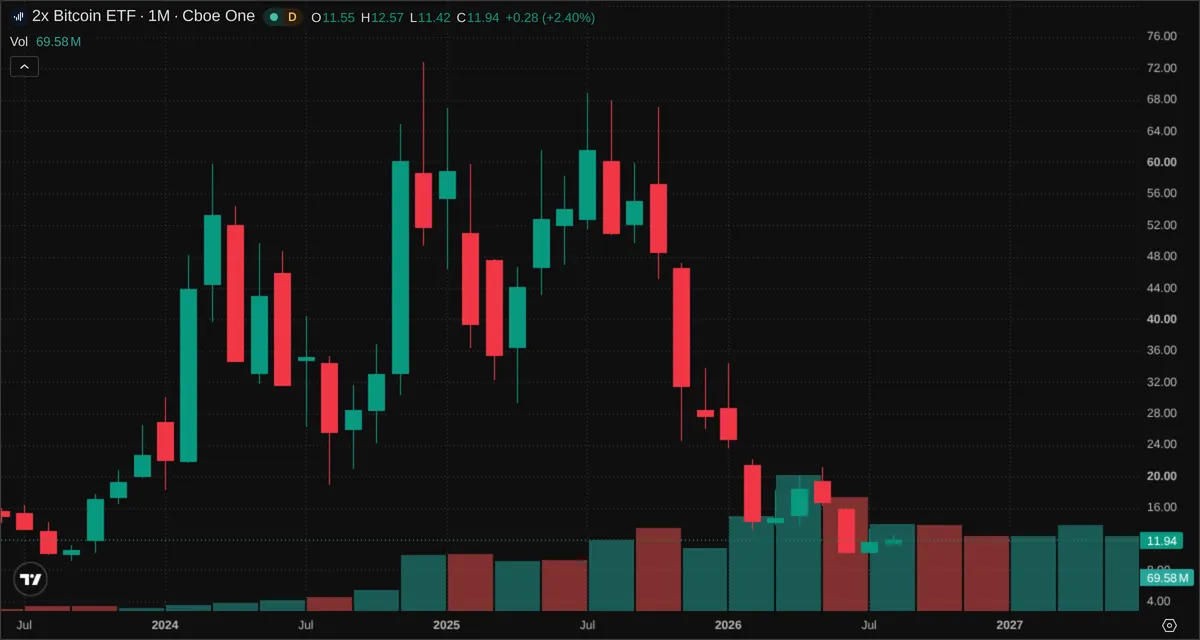
The 2x leveraged BITX over the same window: from $15 to the high and back below $12. Source: TradingView.
Daily rebalancing is not the whole explanation. In August 2025 BITX stood at 5.4 times its starting level, ahead of Bitcoin itself at 4.0 times, by our calculation, and the fund’s audited reports show it up 193% and 204% at two of its anniversaries. Leverage multiplies the way back down as well, and Bitcoin’s slide from its high took the lead away.
What the two-times funds have delivered
BITX has traded since 27 June 2023 and carries total annual costs of 2.75%. Its assets stood at $836m on 14 August 2026, against $2.25bn on 28 February 2025. The Ethereum equivalent, the 2x ETHU, launched on 4 June 2024, costs 2.97% a year and held $718m on 14 August 2026.
Measured to 30 June 2026, the BITX return since inception was minus 7.91% cumulative on net asset value, with minus 78.93% over one year and minus 29.76% in the second quarter of 2026. ETHU stood at minus 96.15% cumulative since inception on the same date, minus 79.61% over one year and minus 48.81% in the quarter. Those are figures dated 30 June 2026, not today’s readings.
The ETHU number is cumulative rather than an annual average, and the audited report settles the point: $10,000 put in at launch was worth $662 on 28 February 2026. A loss of that size averaged every year would have left about $11 after two years, by our calculation.
ETHU also went through a one-for-twenty reverse split on 9 April 2025, where twenty old shares became one new share and the value of the position stayed put. The trust’s Solana and XRP funds did the same by 27 February 2026.
What UK clients can buy while the SEC decides
Neither crypto fund would be within reach of a UK retail investor. The FCA opened retail access to crypto exchange-traded notes on a recognised UK exchange on 8 October 2025, but left its ban on crypto derivatives for retail clients in force. A crypto ETN admitted to the London Stock Exchange has to be physically backed, cannot be leveraged, and may track only Bitcoin or Ethereum. Those notes are classed as Restricted Mass Market Investments and are not covered by the Financial Services Compensation Scheme.
A triple-leveraged crypto product does exist in Europe. The Leverage Shares 3x Long Bitcoin ETP, ticker BTC3, charges 2% a year, listed on SIX Swiss Exchange on 25 November 2025 and also trades on Borsa Italiana. It is registered for distribution in twelve countries: Austria, Germany, France, Italy, Spain, the Netherlands, Belgium, Denmark, Sweden, Finland, Norway and Switzerland. The United Kingdom is not one of them, and the 2x HANetf product, ticker 2LBT, is not registered for the UK either.
In the European Union the American funds are out of reach of retail buyers for a separate reason. The PRIIPs regulation, EU 1286/2014, in force since 1 January 2018, requires a key information document, and US funds do not issue one. That bars the offer rather than the ownership: an existing position can be held or sold, only not added to at an EU broker.
The next fixed date belongs to the SEC. It has 45 days from publication in the Federal Register, with the option to extend to 90, to approve the rule change, reject it, or open proceedings on rejecting it.